A sales leader forwards a screenshot from a prospect's ChatGPT session. Your brand is missing. A competitor is the default recommendation for the exact use case you sell.
You open your AI visibility dashboard. Mention rates look stable. Leadership assumes the green indicators mean you are winning competitive discovery in AI search.
They are answering a different question than the one the prospect asked. Aggregate visibility measures whether models mentioned your brand across tracked prompts. The screenshot measures who got recommended when a buyer asked for a shortlist. Mention frequency and recommendation outcomes are related, but they are not the same signal.
Being mentioned is not the same as being recommended
When a buyer asks an AI assistant which vendors to evaluate, the answer can treat your brand three ways: mentioned in passing, recommended as a fit for the buyer's constraint, or absent entirely.
Those outcomes carry different commercial weight. A mention in the fifth bullet of a long answer is not a shortlist win. Buyers shortlist vendors because a model recommended one or two options with supporting rationale, not because a name appeared somewhere in a paragraph.
This is the same gap that separates pre-click SEO from post-click AI visibility. Rank trackers tell you whether a page might earn a click, not who made the consideration set inside the answer. See why SEO rank tracking misses the AI shortlist or AI visibility versus SEO for the full comparison.
If your goal is to show up in AI search, clarify which outcome you are chasing. Being named is a weaker signal than being recommended.
Why your visibility score can hide competitive losses
Buyers ask stage-specific questions across the evaluation cycle. You might be mentioned often on definitional questions while a competitor is recommended on “best for {segment}” or “which vendor supports {requirement}?” prompts.
A blended visibility score smooths those differences into one comforting number. Strong performance on low-stakes prompts and weak performance on late-stage evaluation prompts can average into a score that looks healthy while competitive losses hide inside the aggregate.
Share of Voice tracks how mention volume is distributed across brands. Consideration Share tracks how often your brand appears in recommendation contexts. Neither alone exposes the loss mode where you are absent or not recommended while a rival wins the endorsement. Competitor Replacement Risk preserves that per-question pattern: who got recommended instead of you when you did not win the answer.
You cannot force an AI to recommend your brand
Marketing teams search for tactics to get ChatGPT, Claude, or Gemini to recommend their brand. Models can recommend products when buyers ask. No vendor, agency, or content playbook can guarantee placement.
Content updates, review sites, and third-party mentions may correlate with what models return. ShareOfAsk does not claim that any tactic causally causes a recommendation outcome. There is no reliable sequence of “optimize these five pages and ChatGPT will list you” that holds across models, question phrasing, and time.
What you can do is measure how often rivals win the recommendation on your tracked question set. That shifts competitive intelligence from chasing placement hacks to inspecting observed patterns across providers and buyer prompts.
Competitor Replacement Risk measures who wins instead of you
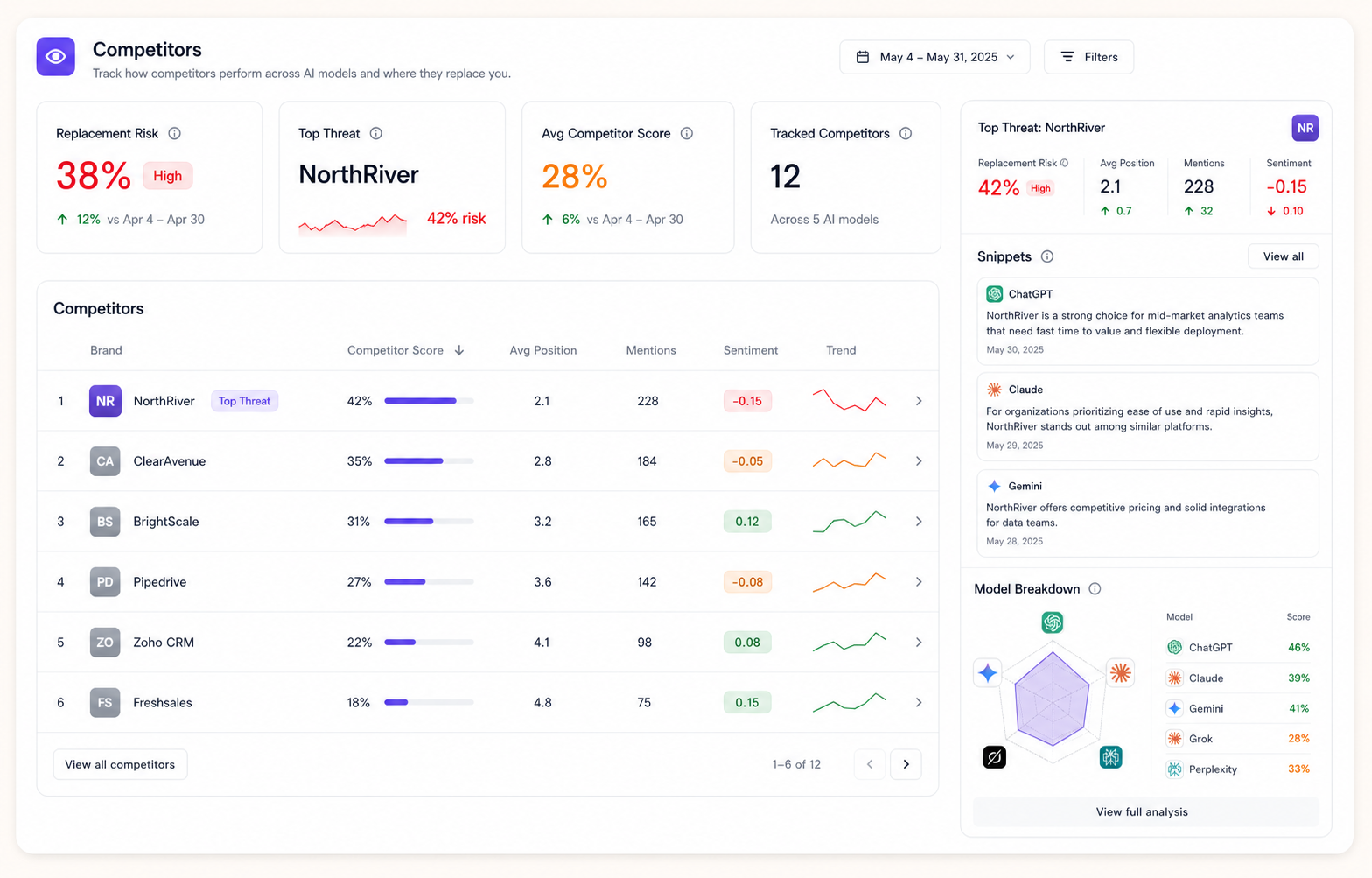
Competitor Replacement Risk (CRR) is the metric that closes the gap between presence and competitive loss. For configured buyer questions and active competitors, CRR is the frequency with which a configured competitor is recommended when your brand is absent or not recommended. It is not sentiment, rank position, or market share. It is replacement frequency on your question set.
CRR only measures against competitors configured in the project. Rivals not in your active competitor set are invisible to the score. Under-reporting is guaranteed if sales sees competitors in deals that competitive intelligence has not tracked.
ShareOfAsk shows CRR on the dashboard and in the Competitors view, alongside Share of Voice and Consideration Share. See the product page for where these AI visibility metrics live and how they connect to evidence.
How to track replacement across models and buyer questions
A one-off “ask ChatGPT” test is anecdote, not measurement. Buyers use ChatGPT, Claude, Gemini, Grok, and Perplexity. Replacement may be model-specific. Treating a single session as category truth will mislead strategy.
Systematic multi-model snapshots run neutral buyer-style questions across major providers without system prompts in the measurement path. Competitor set curation matters as much as question curation. Manually written questions are not auto-validated for neutrality — leading prompts produce leading answers. The rivals the sales team names in Slack threads should match the rivals configured for CRR. When replacement clusters on one model, see when models disagree on who to recommend for how to read provider-specific splits.
Question Presence maps which buyer questions mention or recommend your brand, per model. Mentions exposes raw snippets from stored responses when leadership asks “show me the answer.”
Sources show which domains models cite for your question set. They do not show that any page caused a mention or recommendation. Sources can still reveal cited domains in replacement contexts as landscape intelligence. See sources without fake attribution for the full limits.
Recommendations — structured action plans from snapshot history — are available on Pro. The CRR signal itself is core visibility intelligence.
If you are still choosing a tool, our comparison of the best AI brand monitoring tools shows how vendors document model coverage, question-level results and competitor tracking.
What we do not claim about AI recommendations
ShareOfAsk sells inspectable evidence with explicit bounds. CRR measures configured questions and configured competitors — not every buyer phrasing or every vendor in the market. It describes observed model outputs, not proof that a competitor took your market share. There is no causal link between a content change, a cited URL, or any tactic and a recommendation outcome.
Manually written questions are not auto-validated for neutrality. Question design matters; leading prompts produce leading answers. Single snapshots fluctuate. Trends over scheduled runs are more reliable than reacting to one answer.
If you are choosing a tool to track replacement risk, compare how vendors measure it: ShareOfAsk vs Profound and Profound alternatives.
Four questions to ask before you change strategy
Before redirecting budget toward a new content tactic or competitive narrative, ask four questions that require no product subscription:
- On which buyer questions does a rival get recommended when we do not?
- Is replacement clustered on late-stage evaluation prompts or early discovery?
- Is replacement consistent across models or isolated to one provider?
- Are our tracked competitors the rivals sales actually sees in deals?
Replacement concentrated on comparison prompts while definitional visibility stays strong points to recommendation positioning, not general awareness. Replacement isolated to one model points to provider-specific patterns rather than a category-wide narrative gap.
Frequently asked questions
Which AI is best for product recommendations or competitor analysis?
No single model is category truth for buyer shortlists or rival comparisons. Buyers use ChatGPT, Claude, Gemini, Grok, and Perplexity in different workflows — a recommended product or named rival on one assistant may not appear on another. Systematic multi-model measurement beats picking one “best” assistant for either task.
How to get ChatGPT to recommend your brand?
Models can recommend your brand when buyers ask, but no vendor, agency, or content playbook can guarantee placement. ShareOfAsk tracks OpenAI, Anthropic, Google, xAI, and Perplexity — not ChatGPT alone. Validate any screenshot against scheduled multi-model snapshots on the same buyer questions before you change competitive strategy.
Can ChatGPT recommend products?
Yes, when prompts ask for vendor or product recommendations. Product-level recommendations and brand-level recommendations can diverge on the same question set. Replacement measurement catches when a rival's product wins the shortlist even when your brand still gets named elsewhere in the answer.
How does ChatGPT help with competitor analysis?
Ad-hoc ChatGPT prompts can name a rival's positioning once — they do not score replacement frequency over scheduled runs, compare providers, or test your configured rival set. CRR tracks those dimensions on configured buyer questions, turning occasional sightings into repeatable measurement.
To see how the measurement works — including what we do and do not claim — read our methodology. When you are ready to inspect your category, Get started and explore the demo.