Your earned-media report now includes domains cited in ChatGPT answers. SEO asks which URLs “won.” Leadership wants to know whether last month's blog post drove the recommendation.
That reflex is trained by backlinks and rank trackers. A cited URL looks like evidence of influence, and teams already report “our content caused the ChatGPT recommendation” when a domain co-appears in the response. The reframing is simpler than the tooling: chatgpt citations and linked domains in any model answer are landscape intelligence — which properties models reference when answering buyer questions, not proof a specific URL caused your brand mention.
ChatGPT fake references and plausible citations from other providers are common enough that a domain list is telemetry of what the model returned, not a verified bibliography.
Cited domains are landscape signals, not proof a URL caused your mention
When a buyer asks Claude which vendors handle SOC 2 for a 50-person team, the answer may cite G2, a vendor docs page, or nothing at all. Seeing `g2.com` in that response is informative. Concluding “our blog post caused the recommendation because the model cited our domain” is a leap measurement cannot support.
Models generate answers through training data, retrieval where exposed, and synthesis. Measurement captures what the model returned — not the internal retrieval graph behind a single URL. Correlation between a cited domain and a brand mention across snapshots is a hypothesis, not a client deliverable claim.
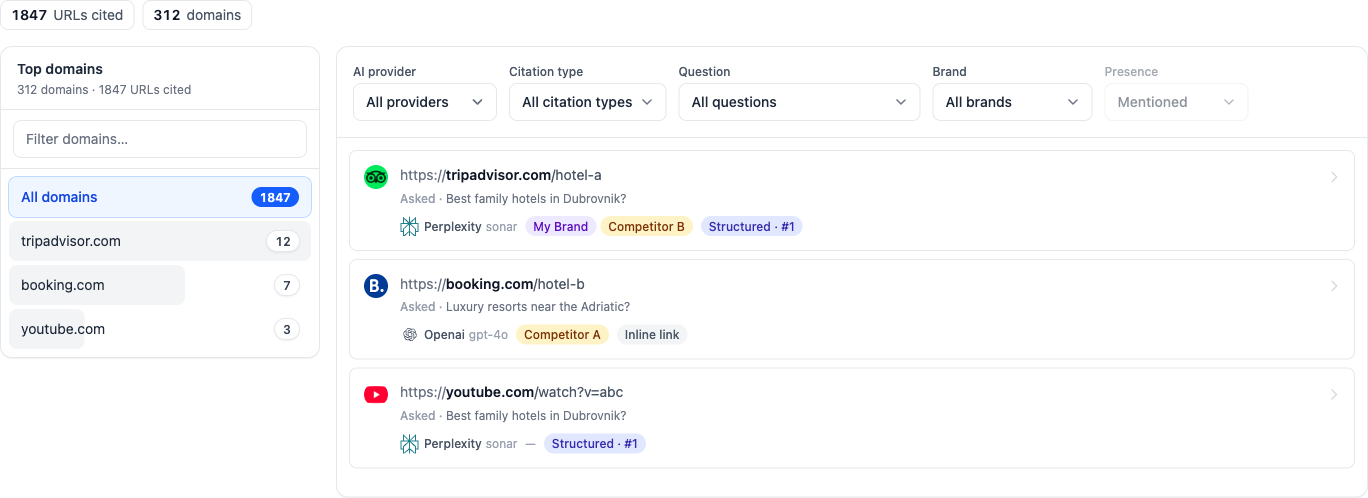
ShareOfAsk Sources aggregates cited domains across multi-model snapshots: which properties appear and how often. Different providers expose citations differently; some answers cite heavily, others barely at all. Sources show which domains models cite for your question set. They do not show that any of those pages caused your mention. Read our measurement principles and limits for the full principles.
Why ChatGPT generates fake references and unreliable citations
Why does ChatGPT generate fake references? Language models can return references that look real — author names, journal titles, URLs — that were never retrieved. They conflate training-memory fragments with live retrieval and format footnotes that do not resolve. Citation hallucination is why landscape reading must precede attribution storytelling.
ChatGPT and other assistants are answer engines, not bibliography tools. ChatGPT is strong at fluent answers and weak at verifiable citations — that is why domain lists are telemetry, not bibliographies. When a model invents fake references, the failure mode is generation outpacing verification — not a broken SEO signal you can optimize into a guaranteed slot. ChatGPT footnotes, Perplexity source cards, and Gemini links follow no single standard; the same prompt can cite heavily on one run and none on the next. Verify URLs independently before you report influence.
How ChatGPT and AI Overviews choose what to cite
“How does ChatGPT choose its sources?” and “How does AI decide what to cite?” describe model behavior — not a formula to optimize one URL for guaranteed mentions.
ChatGPT-style answers draw on training corpora plus optional browsing or retrieval. OpenAI, Anthropic, Google, xAI, and Perplexity each expose different citation behavior; the same buyer question can cite review sites on one provider and vendor docs on another.
Google AI Overviews are search-grounded syntheses: Google retrieves web content for the query, then generates an overview linking to selected sources. “How do AI Overviews choose sources?” is a search-retrieval question first — which pages appeared in that search engine results page (SERP) — layered with summarization. The overview cites pages Google already ranked; it does not certify that any cited URL caused a vendor mention inside the text. Mechanism explains the landscape. It does not license attribution.
AI citations in model answers appear as numbered footnotes in ChatGPT, source lists in Perplexity, and linked cards under AI Overviews. Formats differ; the interpretive rule is shared. Each format shows which domains the system attached to that answer, not proof those domains drove a recommendation about your brand.
What AI Overviews and AI citations actually show
Cited domains are the reference environment around category answers — patterns across your question set, not URL-level causation. AI Overviews are Google's generative summaries atop select search results, with linked sources from the result set. AI citations here mean inbound references inside model answers — footnotes, linked domains, “according to” lines — not bibliography entries in human-authored work.
Is AI Overview ChatGPT?
No. AI Overviews are a Google search product grounded in Google's index. ChatGPT is an OpenAI conversational assistant with its own training and citation UI. Buyers encounter both in evaluation — comparing ai overview citations to chatgpt citations is useful pattern data, not duplicate proof of influence.
What patterns matter for landscape reading
Landscape reading centers on pattern types: review-site dominance versus vendor-docs lag, and whether providers cite different properties for the same prompt. Those patterns are useful context for PR, reviews, and docs planning — not proof that any tactic will earn a citation or a mention.
What we do not claim about sources
Sources show which domains appear in model answers — not proof any cited page caused a brand mention. Citation exposure varies by provider; do not assume uniform citation UI or complete retrieval transparency.
This article covers inbound citations: what models cite when answering buyer questions. It does not provide APA or MLA rules for citing ChatGPT, an AI Overview, or Google AI in papers or reports. ShareOfAsk measures what models returned, not how humans should footnote them.
Landscape measurement differs from citation-generator workflows. Bibliography tools solve a writing task; Sources solves an intelligence task — which domains recur across your question set and how patterns shift over snapshots. Evidence-backed action plans are available through Recommendations on Pro, grounded in what models returned, not invented attribution chains.
How to read citation lists without overclaiming
Ask whether third-party domains dominate evaluation answers in your category, whether your domain appears on integration questions but not pricing, and whether ChatGPT, Claude, Gemini, Grok, and Perplexity cite different properties for the same prompt — not whether one post caused the recommendation or which single URL guarantees inclusion. A domain list cannot answer causal or guarantee questions alone.
Pair citation patterns with mention outcomes. ShareOfAsk Sources landscape shows the citation landscape across snapshots. Mentions shows snippet context from raw responses. Question Presence shows which buyer questions mention your brand per model — related views, not one causal chain. If your domain is cited but your brand is not mentioned, the model referenced your property without naming your brand. Competitor Replacement Risk shows when configured rivals win those slots — landscape data, not citation causation.
Frequently asked questions
Can you trust ChatGPT references?
Trust the list as telemetry of what the model returned, not as a verified bibliography. Open cited URLs independently. Use domain frequency across snapshots for landscape reading; use single citations for verification, not influence reporting.
Can I trust the info from AI Overview?
AI Overviews are search-grounded but still synthesized. Treat linked sources as landscape context around the query. They are not a guaranteed factual chain to your brand.
Why is ChatGPT so bad at citing sources?
For GTM reporting, treat citation quality as a separate problem from answer fluency. Compare domain lists across snapshots and providers before you report influence. Pair cited domains with mention outcomes — a heavy citation list with no brand mention is a landscape signal, not proof your content “won.”
How to get cited in AI Overviews?
You cannot read a domain list as proof your page “won.” Citation patterns show which property types and domains recur in answers for your question set — useful context for PR, reviews, and docs planning, not proof that any tactic will earn a citation or a mention.
What triggers Google AI Overviews?
Google shows overviews for many informational and commercial queries where synthesis adds value atop traditional results. Search-side overviews expose linked domains in SERPs; chat assistants expose different citation behavior. Neither promises that optimizing one page forces a citation.
Can citations be detected as AI?
Formatting cues can suggest AI-generated reference lists. Detection is a verification step, not a substitute for checking whether cited URLs resolve and support the claims in the answer.
To see how the measurement works — including what we do and do not claim — read our methodology. When you are ready to inspect your category, Get started and explore the demo.