A single missing mention can send a brand team into an unnecessary rewrite. A single favorable recommendation can create the opposite problem: confidence built on one answer that disappears a week later.
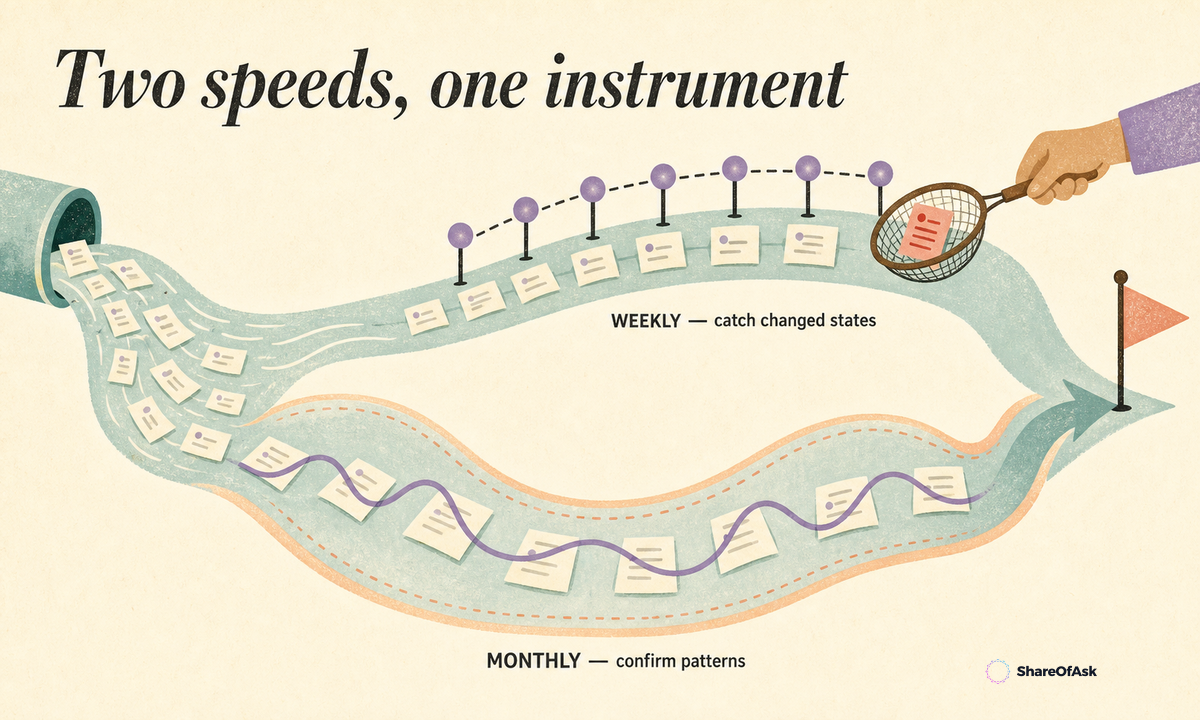
The fix is a two-speed monitoring cadence. Use weekly reviews to catch material changes on priority buyer questions. Use monthly reviews to decide whether those changes form a pattern worth reporting, investigating, or acting on.
Why LLM answer monitoring needs two speeds
Here, LLM answer monitoring means tracking what public assistants say when buyers ask category, comparison, and recommendation questions. It differs from production LLM observability, which focuses on an application’s latency, cost, reliability, and output quality.
Generative output varies. OpenAI’s evaluation guidance explicitly describes models as variable and recommends structured, continuous evaluation against task-specific tests. Public answer monitoring has the same instrumentation problem: if the questions, models, or scoring rules keep changing, a trend line won’t tell you much.
Our measurement methodology controls what can be controlled. We run neutral buyer-style questions without system-prompt injection, preserve unmodified responses, and retain per-model evidence. Sampling, provider updates, retrieval changes, and model drift still exist. A fixed instrument improves comparability; it doesn’t make every answer deterministic.
That leads to a useful division of labor. Weekly monitoring catches changed states and urgent exceptions. Monthly monitoring measures persistence, direction, and competitive meaning.
The cadence at a glance
| Review job | Weekly | Monthly |
|---|---|---|
| Primary question | Did something material change? | Has a meaningful pattern developed? |
| Unit of analysis | One priority question on one model, tied to its raw answer | A stable cohort by question cluster, funnel stage, model, and competitor |
| Best signals | Present-to-absent changes, recommendation losses, competitor replacement, risky framing, run failures | Coverage trends, consideration, competitive share, persistent disagreement, recurring source patterns |
| Reasonable action | Verify, classify, assign, or hold for confirmation | Change priorities, refresh the question set, brief leadership, or fund an investigation |
There is one exception to this cadence. A materially false answer involving safety, legal exposure, compliance, or serious reputation risk deserves immediate review, even if it appears only once. Waiting for a monthly pattern would be poor risk management.
What belongs in the weekly review
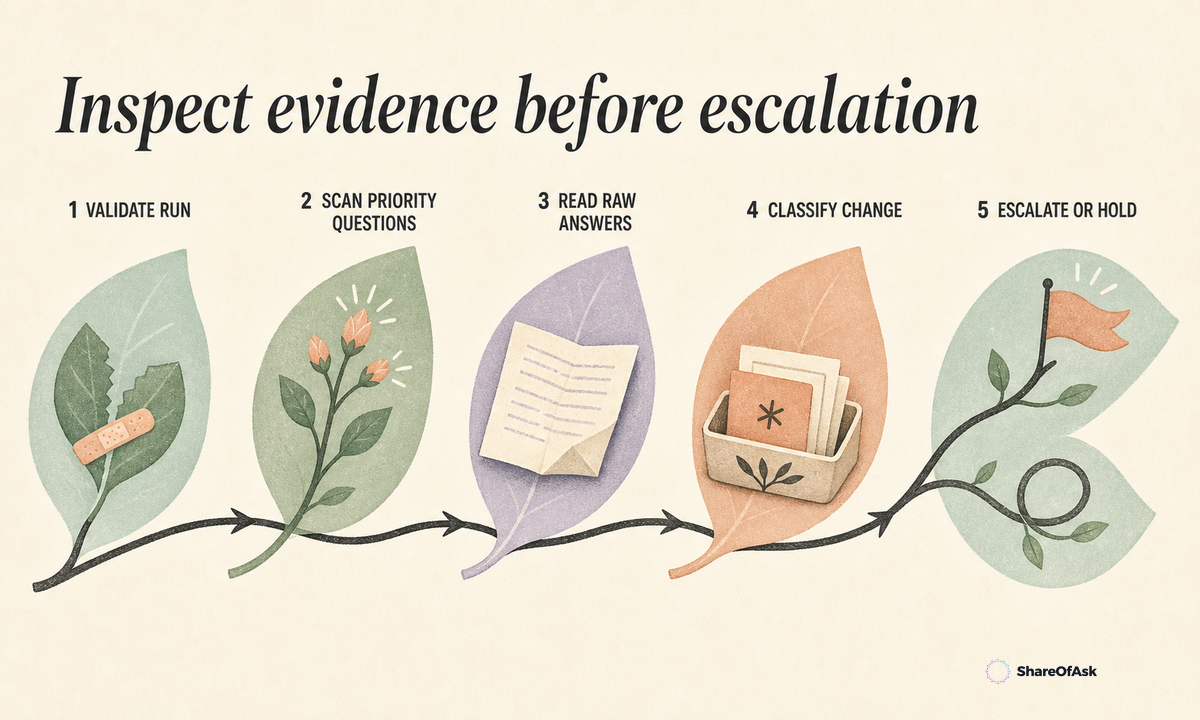
Start with instrument health
Check whether the scheduled run completed across every provider configured for the project before interpreting any movement. Reviewing ChatGPT, Claude, Gemini, Grok, and Perplexity together requires a plan that includes all active models, currently Pro or an applicable custom plan; Entry supports up to three models per snapshot. A failed provider call, partial snapshot, or extraction error can resemble a sudden visibility loss.
Confirm that the same question wording, competitor set, and classification rules were used. If the instrument changed, label the run accordingly. Don’t fold it silently into a continuous series.
Prioritize questions closest to a shortlist
Broad category questions are useful context, though they rarely deserve the first look. Start with questions where an answer could shape evaluation: “best for” shortlists, direct comparisons, integration requirements, risk concerns, and procurement constraints.
Review each priority question by model. A rollup may remain stable while your brand disappears from a late-stage question that matters. Our guide to per-question AI visibility explains why a coverage map is the necessary check behind an aggregate score.
Separate mentions from recommendations
A brand can remain visible while losing the shortlist. Look for changed states such as recommended to mentioned, first choice to secondary alternative, or present to absent. Then inspect who replaced you.
When competitors are configured, Competitor Replacement Risk helps identify cases where a rival is recommended instead. The weekly job is to open the underlying answer and understand the loss. Was the competitor chosen for a specific segment, requirement, price frame, or implementation concern? That context is more useful than a generic down arrow.
Read the raw language
Automated classifications help you find changes; the raw answer tells you what happened. Read the relevant snippet when sentiment shifts, your positioning changes, or a model states a questionable fact about pricing, security, product availability, or customer fit.
Pay attention to material framing. “Suitable for small teams” can be favorable on one question and limiting on an enterprise comparison. Avoid treating every adjective change as a crisis. The buyer context determines whether the framing matters.
Preserve model splits and citation context
Don’t average away a provider-specific loss. If Claude stops recommending your brand while ChatGPT remains stable, retain that fork and recheck it on schedule. Our analysis of model disagreement shows why per-model results are more actionable than a blended score.
Citation changes belong in the investigation queue. Verify that links resolve and note which domains appear around the answer. A new citation doesn’t prove that a page caused your mention, and one missing source doesn’t establish a visibility decline.
A decision rule for weekly noise
No universal threshold can separate signal from noise for every category and question set. Teams still need a rule before a surprising answer arrives. We recommend this triage rubric:
- Escalate now: The answer contains a materially false claim with legal, safety, compliance, or serious reputation consequences. Preserve the evidence and assign an owner immediately.
- Open an investigation: The change repeats in two consecutive comparable runs, affects at least two related high-intent questions, or appears across multiple models.
- Hold and recheck: The change is an isolated ordering swap, one missing citation, or a single-run omission on one provider with no material risk in the raw answer.
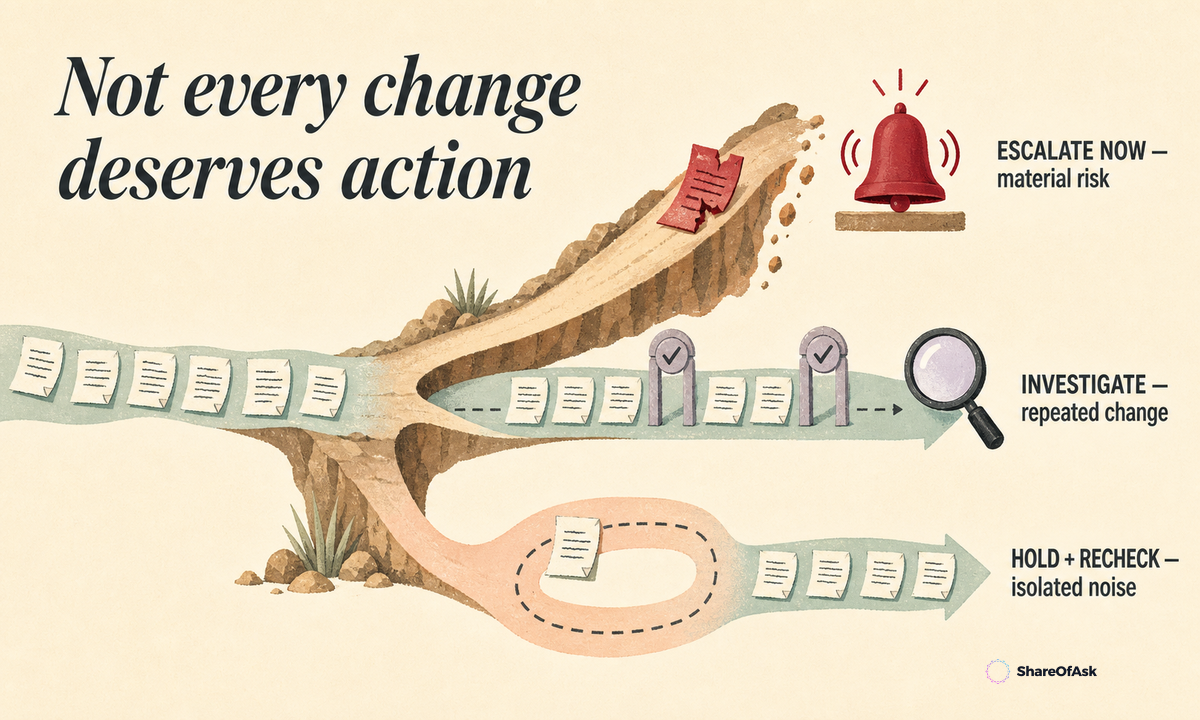
These are operating thresholds, not claims of statistical significance. Tighten them for regulated or high-risk categories. Loosen them only when the cost of investigation is demonstrably higher than the potential impact.
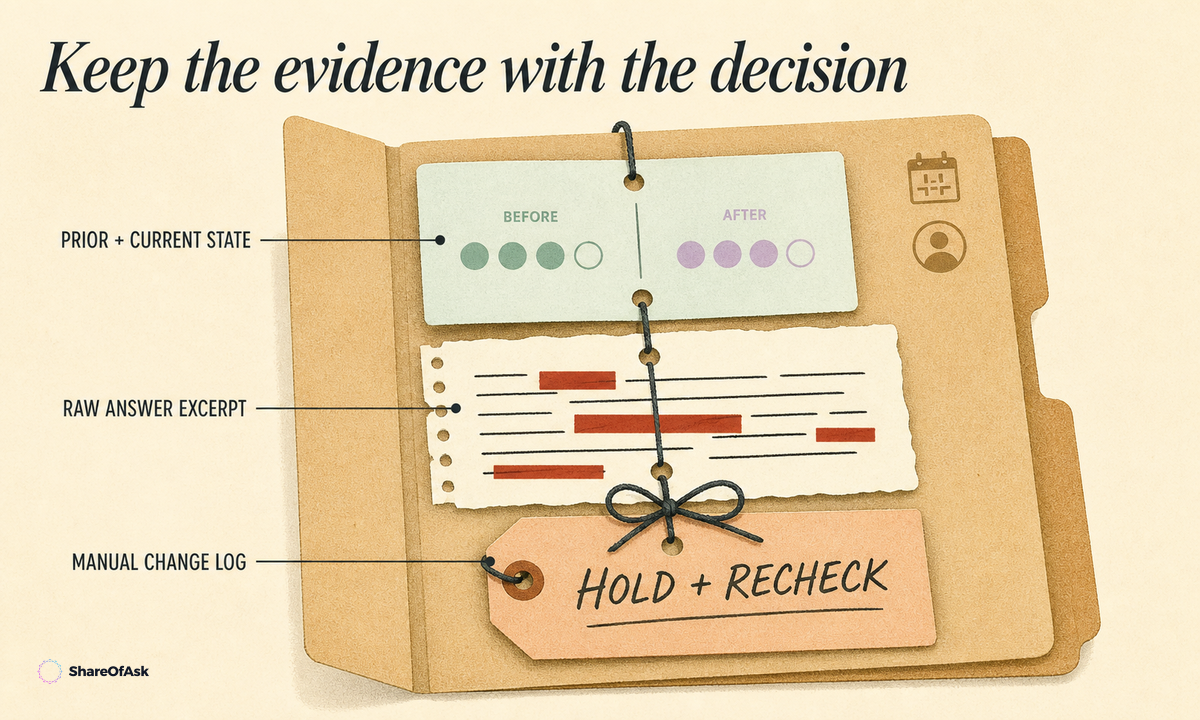
Keep a change log with the question, model, prior state, current state, raw evidence, severity, owner, and next review date. Resist rerunning a prompt repeatedly until the answer looks favorable. That replaces scheduled measurement with answer shopping.
What the reviewer should preserve
Keep the product evidence and the team’s decision together: the prior and current per-model state, the relevant raw-answer excerpt, and the classification recorded in the team’s change log. Redact project, customer, and commercially sensitive details before sharing the record outside the review group.
What belongs in the monthly review
Trend stable cohorts
Monthly analysis should compare like with like. Review presence and recommendation coverage by model, question cluster, and funnel stage across a stable cohort. Look for direction and persistence rather than treating the latest snapshot as the entire story.
Protect the denominator. Record prompt additions, removals, and wording changes. Do the same for competitor-set changes and model availability. When a question set evolves, preserve the prior cohort for historical comparison and report the new cohort separately until it has a usable baseline.

Interpret competitive outcomes
Review Share of Voice, Consideration Share, position, sentiment framing, and competitor replacement together. Each answers a different question. Mention share can rise while recommendation coverage falls, especially if broad informational prompts outnumber high-intent comparisons.
Model disagreement also becomes more meaningful over a month. A one-week Claude gap may vanish. A widening gap across several related questions points to a provider-specific pattern worth examining. Keep the evidence visible rather than compressing five assistants into one “AI visibility” percentage.
Study the citation environment
Monthly review is the right place to examine recurring cited domains and source types. Are review sites becoming more common on shortlist questions? Does your documentation appear around technical evaluations? Do providers rely on different properties for the same buyer need?
Use those patterns as research inputs for content, PR, documentation, and review strategy. Our guide to reading AI citations and sources covers the boundary: source frequency describes the citation environment, while causal attribution requires evidence the answer itself doesn’t provide.
Audit the question set
A frozen baseline shouldn’t become a stale one. Once a month, compare monitored questions with sales calls, win/loss notes, procurement objections, and new segment priorities. Update configured competitors when sales repeatedly encounters a rival that the monitoring set omits.
Version substantive changes. Keep a core cohort stable for trend reporting, then test new questions in a separate exploratory group before promoting them into the baseline.
Give leadership a decision, not a data dump
A monthly readout should include the trend, representative raw evidence, business implication, owner, and next action. Show one or two high-value question gaps rather than filling a deck with every changed answer.
Maintain an intervention log for positioning updates, documentation releases, PR, reviews, and corrected product facts. Compare later answer patterns with that timeline, while describing any relationship as an observation unless you have separate causal evidence.
One framework across ChatGPT, Claude, Gemini, Grok, and Perplexity
Use the same buyer questions, outcome taxonomy, and cadence across all five providers. Preserve each provider’s result. That gives you comparable business outcomes without pretending the assistants behave identically.
Start with presence, recommendation, replacement, position, and framing. Raw citation counts are less comparable because providers expose sources differently. Model and retrieval changes also matter. Google’s Gemini model documentation, for example, distinguishes stable versions from preview, experimental, and “latest” aliases that can change as releases move. Record provider or model changes when that information is available, then inspect any nearby step change as a hypothesis.
If credible buyer-usage data shows that one assistant is especially important to your audience, weight it more heavily in executive prioritization. Keep every provider in the analyst view. A lower-priority model can still reveal an emerging narrative or source pattern before it spreads elsewhere.
ShareOfAsk checks your questions daily on every paid plan, and Free Scan is a one-time check. Compare ShareOfAsk plans to see what each plan includes.
Evaluating monitoring tools for this cadence? See ShareOfAsk vs Peec AI and ShareOfAsk vs Profound.
A workable operating rhythm in ShareOfAsk
Our product is built for this two-speed workflow. ShareOfAsk runs neutral buyer questions across major providers and retains per-model snapshots. Question Presence locates coverage gaps; Mentions provides raw answer context; trends show movement over time; Sources maps recurring cited domains; and Competitor Replacement Risk identifies configured rivals that win recommendations instead.
The triage rubric, named-owner workflow, and change log are team operating practices; ShareOfAsk doesn’t currently send automated threshold alerts or assign issues. A practical setup gives one analyst responsibility for instrument health and weekly triage, then records each escalation and its owner in the team’s work-management system. The monthly review brings in brand or communications, competitive intelligence, content or SEO, and sales evidence. One approver controls baseline question changes so the trend doesn’t drift through casual edits.
ShareOfAsk measures configured questions and competitors. It doesn’t observe every buyer phrasing, and its output history cannot prove why a provider changed an answer. The ShareOfAsk product overview shows how the underlying views connect without collapsing the evidence into one opaque score.
To establish the cadence, freeze a baseline question set, mark the high-intent questions, define severity and confirmation rules, and run the first weekly triage. Reserve broad strategy changes for the monthly review, when repeated evidence can support a decision rather than merely provoke one.