A brand can dominate search results, publish constantly, and still vanish when a buyer asks an AI assistant for three vendors to evaluate. Another company with less traffic may appear immediately, complete with a crisp explanation of who it serves and why it fits.
That difference feels arbitrary when you look for a familiar ranking formula. The provider materials cited here describe different grounding and retrieval approaches; they do not publish a shared cross-provider formula for brand inclusion. Each assistant also has its own models, information sources, and response policies, and the output changes with the question.
There is, however, a useful way to diagnose what you observe. When teams ask why AI models mention some brands and not others, we examine four interacting factors: entity clarity, source repetition, category fit, and answer confidence. They aren’t secret model weights. They’re practical lenses for moving from “we were omitted” to a specific hypothesis that can be tested.
Brand inclusion is a constrained answer choice
An AI assistant usually has more possible brands available than it can sensibly name. A request for “the best expense management platforms for a 200-person company” calls for a useful shortlist, not a directory. The model or surrounding system has to select a manageable set, explain the choices, and stay relevant to the constraints in the prompt.
That makes inclusion question-specific. A brand may appear in a broad answer about project management software and disappear when the prompt adds HIPAA requirements, an enterprise procurement process, or a budget ceiling. The second answer asks the system to qualify the brand, not merely recall its name.
Three outcomes need to stay separate:
- Mentioned: The brand’s name appears somewhere in the response.
- Recommended: The answer presents the brand as an option that fits the buyer’s request.
- Cited: The response links to or identifies a source associated with the answer.
A citation does not prove that the linked page caused the mention. A passing mention does not mean the brand made the serious consideration set. This distinction matters because teams often celebrate any appearance while a competitor receives the actual recommendation.
A four-factor model for brand inclusion
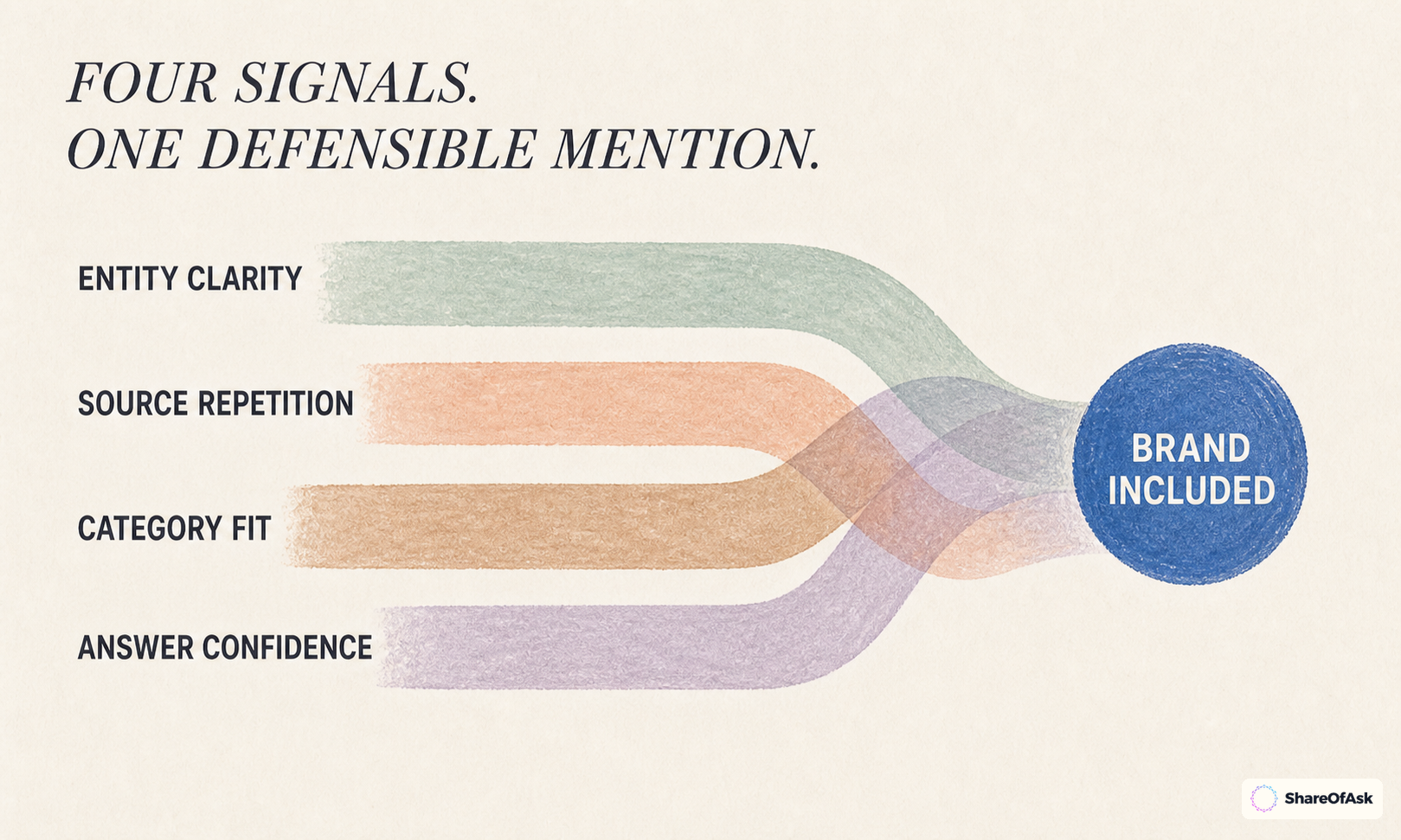
The four-factor model asks a sequence of diagnostic questions, although the factors themselves operate together:
- Entity clarity: Can the system resolve which company or product the name refers to, and attach the right facts to it?
- Source repetition: Does the relationship between the brand, category, audience, and capability recur across relevant material?
- Category fit: Does the brand satisfy the job, segment, and constraints in this particular prompt?
- Answer confidence: Is the available information coherent enough for the system to include the brand with a plausible explanation?
Think of these as pressure points rather than a scorecard. Strong recognition cannot rescue a poor fit for the question. Excellent product fit may remain invisible when the company’s identity is muddled across the web. Repetition can reinforce a clear relationship, yet repetition of contradictory or vague claims may create more ambiguity.
The model is also agnostic about where the answer’s information came from. Some responses rely mainly on knowledge learned during training. Others use search, browsing, product feeds, or retrieval-augmented generation. Google defines grounding as connecting model output to verifiable information sources. The exact source path varies by provider and sometimes by query, but the four lenses remain useful when inspecting the result.
Entity clarity: can the model tell exactly who you are?
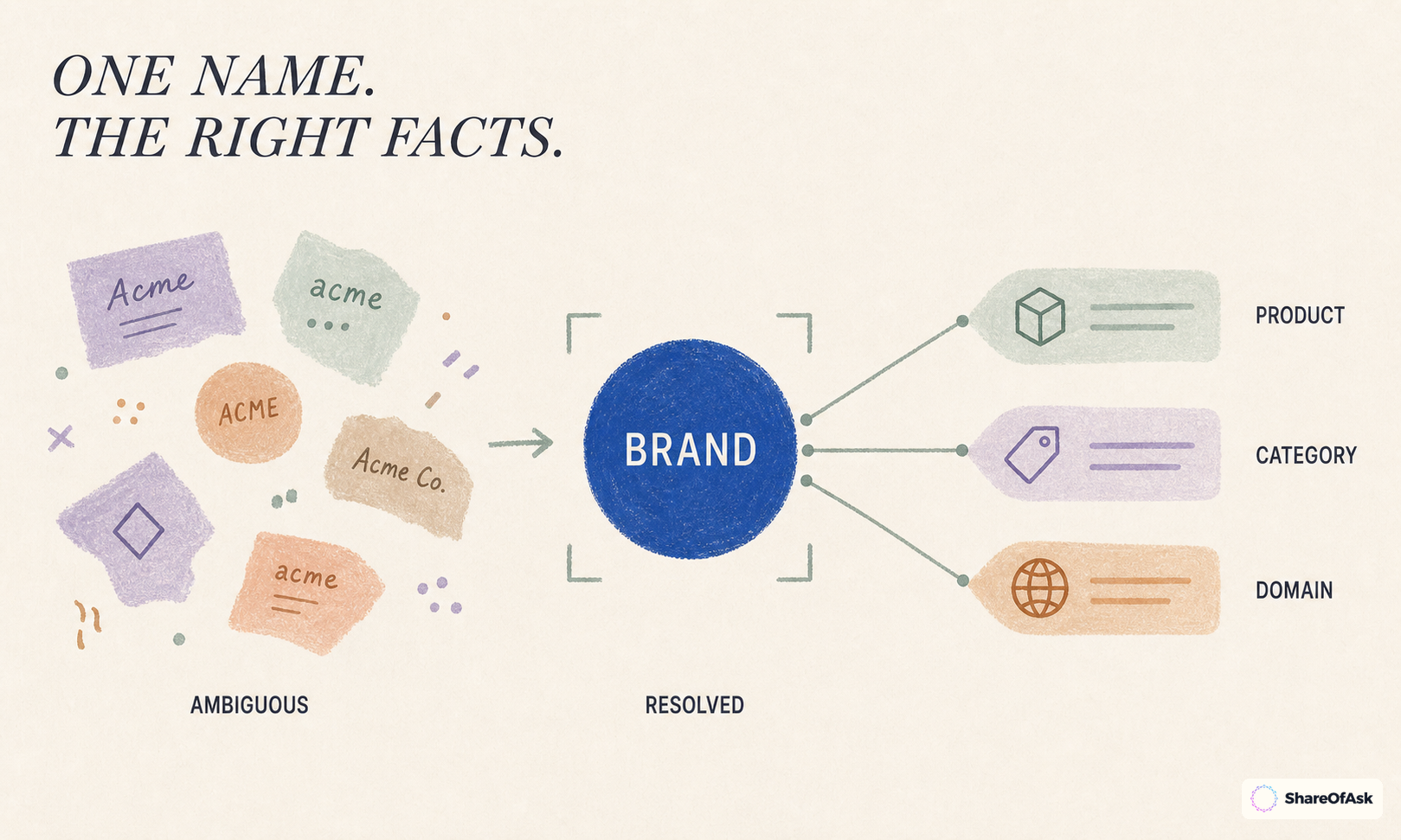
Entity clarity starts with identity. A system should be able to connect a stable brand name to the correct company, products, category, website, and factual descriptions. When those connections are inconsistent, facts can be assigned to the wrong entity or dropped during retrieval.
Where identity becomes ambiguous
Generic names cause an obvious problem. A company named “Flow,” for example, may compete with unrelated products, apps, and common-language uses of the same word. Product-company relationships create a subtler version: the market discusses the product name, the corporate site emphasizes a parent company, and review platforms classify each under a different category.
Rebrands leave similar debris. The homepage uses the new name, old help documents retain the former one, directory profiles point to an outdated domain, and articles describe an earlier positioning. A person can reconcile that history. Retrieval systems working with isolated passages may not.
Anthropic’s work on contextual retrieval illustrates the underlying issue. A passage such as “the company’s revenue grew by 3%” is difficult to retrieve correctly when the chunk lacks the company name and time period. Adding the missing context improves the passage’s retrievability. Brand content has the same practical requirement: important claims need enough local context to identify the company, product, audience, and subject.
An entity clarity audit
Start with the pages and profiles that define the organization. Compare the homepage, About page, product pages, support documentation, major directory listings, and structured data. Look for direct contradictions:
- Does the same brand name and canonical domain appear consistently?
- Is the relationship between the company and each product explicit?
- Do category descriptions agree, or does one page say “analytics platform” while another says “marketing automation suite”?
- Are former names and acquisitions explained clearly enough to connect old references with the current entity?
Organization structured data can help Google understand and disambiguate administrative details such as the organization’s name, URL, alternate names, logo, and profiles. Treat it as a machine-readable clarification layer. Markup does not force an assistant to recommend the brand.
The best evidence of an entity problem appears in raw answers. Watch for an incorrect category, a stale product name, confusion with another company, or features attributed to the wrong offering. Those errors give you a narrower repair target than a generic “publish more” instruction.
Source repetition: is the same relationship supported in enough places?
For category inclusion, examine a specific relationship: “Brand A provides capability B for customer C under condition D.” The evidence here supports checking how often relevant documents connect those facts. It does not establish how models weigh a large volume of vague appearances against a smaller number of precise descriptions.
Research on long-tail knowledge gives this factor a technical foundation, with important limits. In Large Language Models Struggle to Learn Long-Tail Knowledge, researchers found that factual question-answering accuracy in the studied settings related to how many relevant documents appeared in pretraining data. They also found retrieval augmentation could reduce dependence on relevant pretraining information.
That study does not establish a universal threshold for brand mentions. It does support a measured inference: facts and relationships with little documentary support are harder for models to reproduce reliably than well-supported ones.
Repetition must preserve meaning
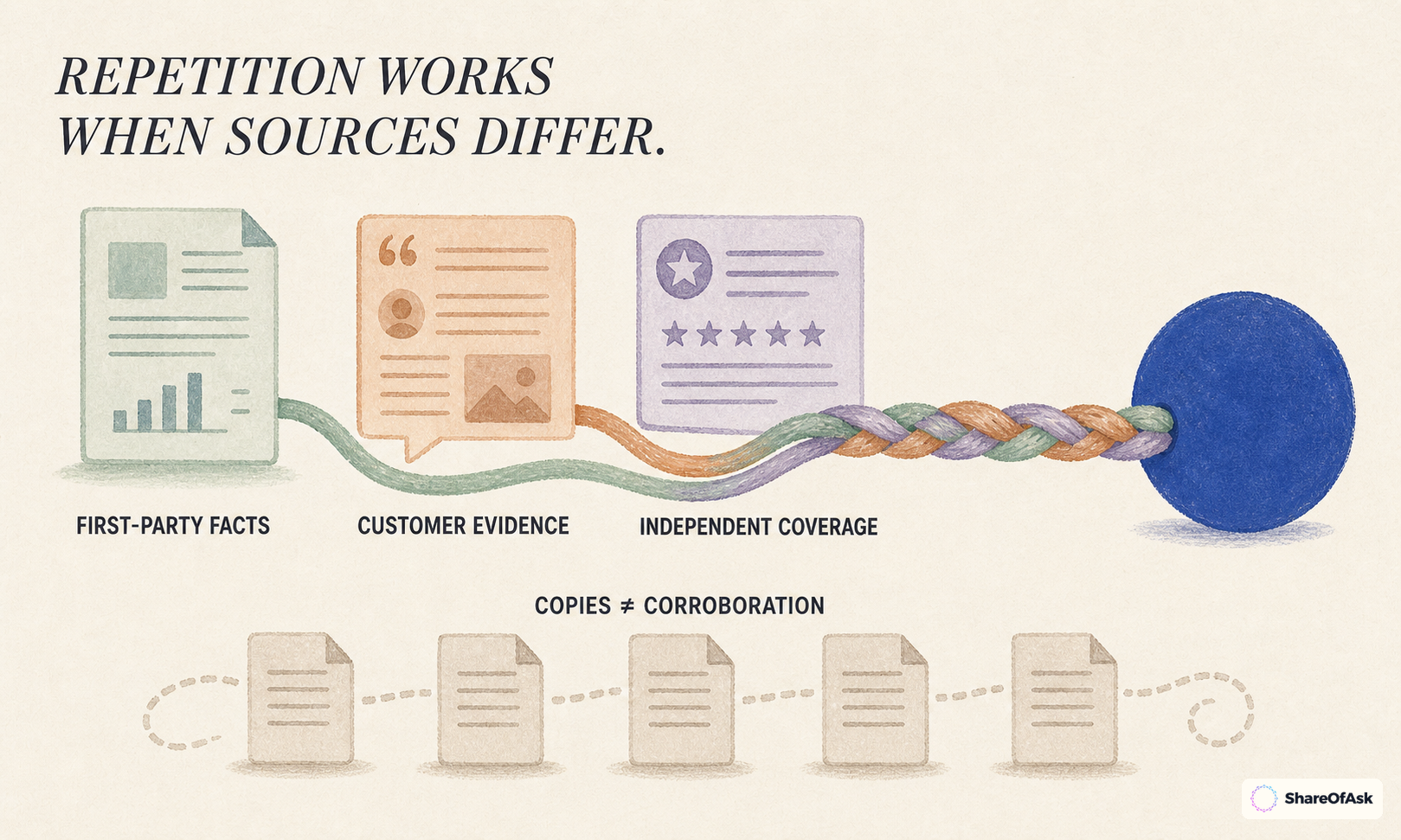
Useful repetition occurs when the same core relationship appears in contexts where it belongs. Your product documentation might specify an integration. A customer case study shows that integration in use. A respected industry directory places the product in the relevant category. An independent comparison describes the audience for whom the capability matters.
These sources have different roles. First-party pages should provide precise facts: supported workflows, limitations, deployment options, pricing terms, and dated specifications. Independent coverage can show that other participants in the market describe the brand in a compatible way.
Mass duplication is a weak substitute. Syndicating one press release across dozens of sites creates many URLs, but those copies often repeat one promotional source. Publishing near-identical location or category pages on your own domain has the same limitation. More pages do not automatically create more independent support.
Training exposure and live retrieval are different paths
A model may have encountered a brand during training, retrieve current web material at answer time, use both, or expose little about the path. This is why citations must be read carefully. A cited review site can tell you something about the reference environment around the answer. It cannot prove that the site caused the model to name a particular vendor.
Our guide to reading AI citations and sources treats recurring domains as citation-landscape intelligence. Compare which properties appear across questions and providers, verify that the URLs support the claims, and resist building a causal story from one source card.
Category fit: does your brand belong in this exact answer?
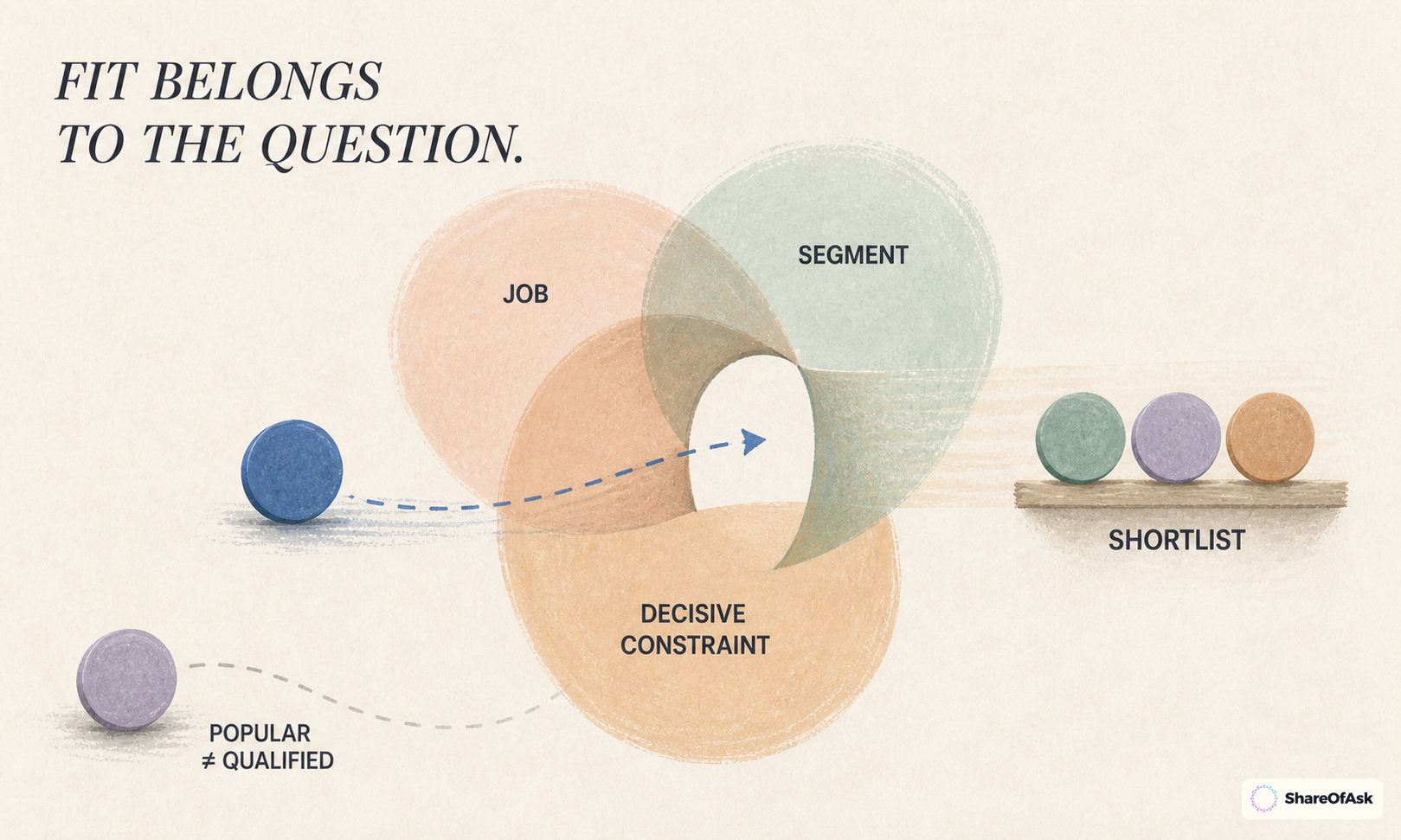
Category fit is the most overlooked factor because teams treat visibility as a permanent property of the brand. In practice, fit belongs to the relationship between a brand and a question.
Consider two prompts:
- “Which customer support platforms should a growing SaaS company evaluate?”
- “Which customer support platforms offer on-premises deployment for a U.S. healthcare organization?”
The first prompt leaves room for a broad field. The second imposes a decisive deployment and industry constraint. A popular cloud-only vendor may reasonably disappear. That omission says little about its overall awareness and a great deal about fit.
The three qualifiers that usually matter most
The job defines what the buyer needs to accomplish. The segment narrows the relevant operating context, such as company size or industry. The decisive constraint filters the shortlist through a requirement such as deployment model, region, integration, or budget.
Vague positioning makes these relationships hard to state. “We help teams work smarter” provides no qualification value. A page that explains which finance teams use the product, what workflow it supports, and where it does not fit gives both readers and retrieval systems more usable context.
This is also why aggregate visibility scores can mislead. A brand may appear on easy category-definition prompts and vanish on the evaluation questions that shape a purchase. Per-question presence exposes that pattern by preserving the individual questions beneath the rollup.
Do not “fix” a category-fit gap by claiming a capability the product lacks. If the buyer requires an unsupported deployment model, omission is accurate. The strategic response may be product development, clearer qualification, or acceptance that the prompt belongs to a different competitive set.
Answer confidence: can the model defend naming you?
Answer confidence is an operational lens, not a claim that marketers can inspect a model’s hidden probability. Ask whether the available material gives the system enough coherent support to name the brand and explain the choice without relying on fragile assertions.
Research suggests that models can show useful self-evaluation behavior under controlled conditions. In Language Models (Mostly) Know What They Know, relevant source materials increased models’ predicted probability that they knew an answer in the studied tasks. The researchers also found limitations when self-evaluation had to generalize to new tasks. That nuance matters: confidence behavior exists, yet it is neither uniform nor perfectly calibrated.

What weakens a supportable answer
Contradictions are the clearest problem. One official page says the product serves small businesses, another targets global enterprises, and a third-party profile has pricing from three years ago. The assistant now has to resolve which description applies.
Unsupported superlatives create another weak foundation. Claims such as “the most secure platform” or “the leading solution” require evidence and a defined comparison. Concrete statements are easier to qualify: certification status, supported regions, named integrations, deployment options, or the date a pricing policy took effect.
If omissions, cautious descriptions, or unstable inclusion appear alongside conflicting positioning or stale facts, treat that pairing as a diagnostic hypothesis. It does not show that the contradiction caused the answer. Correct the conflicting material, keep the buyer question and model fixed, and compare several later snapshots; even a directional change supports further testing rather than revealing the model’s internal mechanism.
The four factors interact, so diagnose the pattern
No external observation reveals a model’s internal causal chain. The practical move is to match an observed pattern with the narrowest plausible factor, then run a test that could disconfirm your hypothesis.
| Observed pattern | Plausible factor | Next test |
|---|---|---|
| The answer uses the wrong category, old name, or another company’s facts. | Entity clarity | Compare identity facts across first-party pages, profiles, structured data, and the passages cited or quoted in answers. |
| The brand appears on broad category prompts and disappears when a segment or requirement is added. | Category fit | Check whether the product truly meets the constraint and whether a clear, accessible page documents that relationship. |
| The brand’s own site makes a claim that rarely appears elsewhere, while established competitors are described consistently across relevant sources. | Source repetition | Map recurring brand-category-capability relationships across first-party and credible third-party material. |
| The brand appears with hedged wording, changes position frequently, or drops in and out across comparable runs. | Answer confidence | Look for contradictions, stale facts, unsupported claims, and missing qualification details; then trend repeated snapshots. |
| One provider recommends the brand consistently and another omits it on the same questions. | Provider-specific retrieval, learned knowledge, or framing | Compare raw responses, exposed citations, and repeated results by model rather than relying on one blended score. |
Cross-model disagreement is especially informative. Providers do not share one training corpus, retrieval stack, update schedule, or response style. Our guide to ChatGPT and Claude disagreement explains why those forks should remain visible. An average can turn one provider’s complete absence and another’s strong recommendation into a bland middle value that no buyer actually experiences.
To run this diagnosis on your own category, keep the questions and models fixed between checks and read each result by question and model. Our AI visibility methodology explains what each metric measures and what it does not claim.
A practical diagnosis workflow
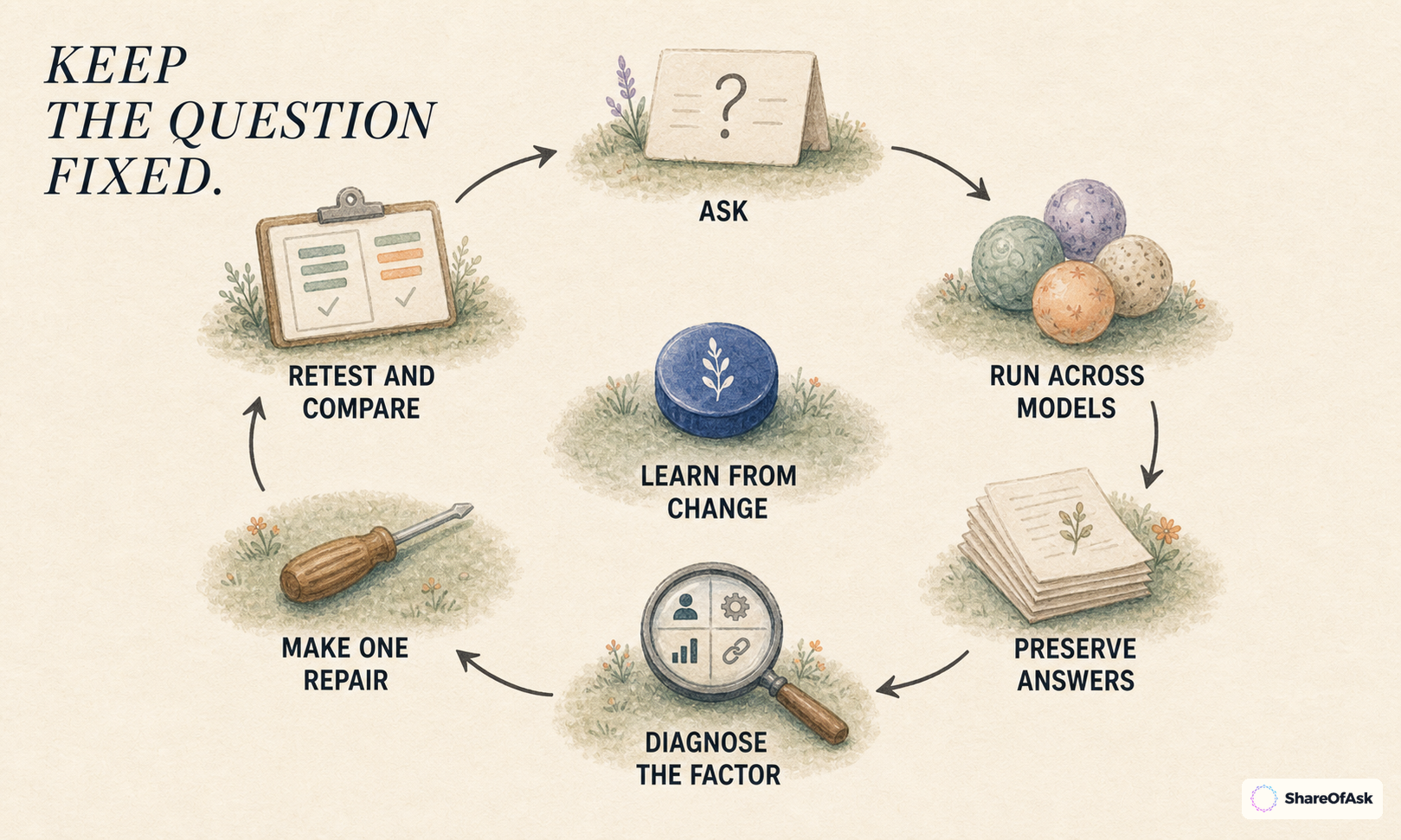
The four factors become useful when the measurement process preserves the question, model, and original answer. A weekly screenshot from one employee’s personal chat cannot do that reliably.
Build a buyer-question set
Start with eight to twelve questions drawn from sales calls, win-loss notes, and actual evaluation criteria. Cover category entry, shortlist formation, comparison, and risk. Avoid writing ten cosmetic variations of “best tools.”
Keep each question neutral. “Which platforms should a 100-person U.S. fintech evaluate for customer identity verification?” can reveal a market pattern. “Why is our platform the best identity solution?” measures prompt steering.
Preserve the evidence
Run the same questions across the providers your buyers are likely to use. Store the unmodified response and classify the outcome:
- Was the brand absent, mentioned, or recommended?
- Which competitors appeared, and which received a clear endorsement?
- How did the answer describe the brand’s audience, strengths, and limits?
- Which sources were exposed, if any?
Now select a commercially important gap. If your brand disappears only when the prompt adds an enterprise security requirement, begin with category fit and answer confidence. If the answer confuses your product with a similarly named service, start with entity clarity. The table narrows the investigation; it does not certify the cause.
Use repeatable multi-model measurement
We built ShareOfAsk for this diagnostic workflow. We run neutral buyer questions across major AI models without injecting system prompts into the measurement path. Question Presence shows where the brand appears by question and provider. Mentions preserves snippets and response context from the unmodified answers. Competitor Replacement Risk identifies configured rivals that receive the recommendation when your brand does not. Sources maps the citation environment around the question set.
Those views let a team connect an aggregate movement to the answers beneath it. They do not reveal a provider’s private training data or prove that one URL caused a mention. Sampling, model drift, question design, and extraction error remain real constraints, so trends across scheduled snapshots carry more weight than a single run.
SEO myths that send diagnosis in the wrong direction
Traditional search data still matters for indexed discovery, technical health, and traffic. It does not answer whether a brand entered a synthesized shortlist. A rank tracker measures URL positions for known queries. AI visibility measures brand presence and competitive framing inside answers to buyer questions.
That difference breaks several tempting shortcuts:
- “We rank first, so models should mention us.” Search position is not proof of answer inclusion, particularly across assistants with different retrieval behavior.
- “Adding more category keywords will fix it.” Repeated terms cannot repair an ambiguous entity, an unsupported capability, or a genuine mismatch with the prompt.
- “Schema guarantees recommendation.” Structured data can clarify machine-readable identity. It is not a placement command.
- “A clever system prompt proves visibility.” Hidden instructions can manufacture the result the test was supposed to observe.
Sound web practices still contribute useful inputs: accessible pages, clear facts, coherent entity information, well-maintained documentation, and credible independent coverage. The mistake is treating them as a published recipe for guaranteed inclusion. For a deeper comparison of the measurement layers, read AI Visibility vs SEO.
Choosing a tool to run this diagnosis? Compare ShareOfAsk vs AthenaHQ or browse Profound alternatives.
What to change first
Start with the weakest factor attached to a question that matters commercially. Identity contradictions deserve first priority because they contaminate every category relationship built on top of them. Fix names, product-company connections, canonical URLs, stale profiles, and conflicting descriptions before commissioning another broad content campaign.
Next, address the highest-value fit gap. If buyers evaluate your category through a specific integration, deployment model, or company-size constraint, document the facts clearly. Include boundaries. Qualification is more credible when a reader can see where the product fits and where it does not.
Then strengthen the surrounding evidence. Publish precise first-party material and pursue credible third-party descriptions where there is a real story to tell. Measure citation patterns as context, without turning every linked domain into an attribution claim.
Finally, rerun the same neutral question set across multiple models. Look for directional change over several snapshots: fewer identity errors, stronger qualification language, improved presence on priority questions, or reduced competitor replacement. If the pattern does not move, revisit the hypothesis instead of repeating the same tactic at greater volume.
AI brand inclusion will never be fully explained by an outside observer looking at outputs. It can still be diagnosed with discipline. Keep the question fixed, preserve what each model returned, identify the weakest of the four factors, and test one plausible explanation at a time.