
A brand can rank well, publish constantly, and still disappear when a buyer asks an AI assistant which vendors deserve a closer look. By the time that buyer reaches Google or your website, the assistant may already have narrowed the field to a small set of vendors.
Improving that outcome requires more than adding “AI” to an SEO checklist. You need to find the recommendation prompts where your brand loses, inspect the public evidence available for those decisions, and repair the specific gaps that affect how your company is understood and compared.
AI visibility here means your brand is named and accurately framed when buyers ask category, comparison, and fit questions. A recommendation carries more commercial weight than an incidental mention. Neither can be guaranteed: model outputs vary, providers change, and no page edit forces a place on every shortlist. These nine fixes give you a disciplined way to influence the inputs and measure the result.
| Fix | Symptom | Concrete output |
|---|---|---|
| Map prompt gaps | You have a visibility score but don’t know where you disappear | Prompt-gap register |
| Clarify the entity | Models confuse your company, product, or category | Canonical entity brief |
| Align category language | You appear for broad terms but miss the language buyers use | Category-language map |
| State comparative positioning | Competitors receive a rationale and your brand receives a vague mention | Evidence-backed comparison brief |
| Build constraint-specific pages | You vanish when a buyer adds a segment, region, or requirement | Focused decision page |
| Strengthen the source footprint | Third-party descriptions are thin, inaccurate, or inconsistent | Prioritized source-gap list |
| Publish verifiable evidence | Your claims are generic or difficult to substantiate | Evidence inventory |
| Cover evaluation FAQs | Decisive questions are answered only in calls or support tickets | Owned FAQ backlog |
| Remove technical friction | Important evidence is blocked, gated, or hard to extract | Technical eligibility checklist |
Fix 1: Map the prompt-level gaps first
Start with the questions that could change a consideration set. Sales calls, win/loss notes, support conversations, security reviews, and procurement requests are better inputs than a generic keyword export because they contain the conditions buyers use to eliminate options.
A useful question set covers several moments in evaluation:
- Category entry: “Which inventory management platforms should a regional retailer evaluate?”
- Segment fit: “What customer support tools work well for a 100-person B2B SaaS company?”
- Comparison: “Which alternatives to Vendor X offer stronger role-based permissions?”
- Risk: “Which payroll platforms support multi-state nonprofits?”
- Implementation: “What CRM integrates with NetSuite without custom middleware?”
Keep the wording neutral. “Why is Acme the best CRM?” measures a leading prompt. “Which CRMs fit a 50-person professional-services firm that uses NetSuite?” tests whether Acme enters a realistic shortlist without being coached into the answer.
Record the outcome at the question level
For every question and model, record five fields: whether the brand was mentioned, whether it was recommended, which competitor appeared, how the answer framed each option, and which sources were attached. A rollup percentage alone can hide a damaging pattern. Broad educational questions may produce frequent mentions while late-stage fit questions consistently send buyers to a rival.
Our Question Presence approach preserves that question-level view. ShareOfAsk runs neutral buyer questions across major AI models, keeps the unmodified responses, and lets you inspect Mentions and configured competitor context. That gives you a baseline for the nine fixes instead of a collection of screenshots from personal chat sessions.
The output should be a prompt-gap register with one row per question and model. Give priority to absences on questions that resemble real buying decisions.

Fix 2: Make the brand entity unambiguous
Entity confusion shows up in several forms. An assistant may mistake your company for a similarly named business, recognize a product without connecting it to the parent company, or describe you using a category you left years ago.
Write a canonical description that answers four things in plain language: what the company is, which category it belongs to, who it serves, and how its products relate to the company. Keep it factual enough for your legal, product, PR, partner, and content teams to use consistently.

Then reconcile the visible identity across your homepage, About page, product pages, social profiles, partner directories, review sites, and press materials. Check:
- Official and abbreviated names
- Product names and parent-brand relationships
- Primary URL, logo, and contact details
- Category and audience description
- Acquisitions, rebrands, and retired product names
Give search systems structured facts
Add accurate Organization structured data to the homepage or About page. Google says this markup can help it understand administrative details and disambiguate an organization. Relevant properties include name, url, logo, alternateName, sameAs, and appropriate contact details. Use the most specific subtype that genuinely fits.
Organization markup supports machine understanding in Google Search. It doesn’t promise inclusion in AI recommendations. Its value is straightforward: fewer contradictory clues about who you are.
Fix 3: Use the category language buyers actually use
Many brands describe themselves with language no buyer would put into a recommendation prompt. “An intelligent work orchestration ecosystem” may sound differentiated in a campaign. It gives an assistant little help with a question about project management software for construction firms.
Compare three vocabularies side by side:
- The terms customers and prospects use in calls.
- The category and constraint language in your prompt-gap register.
- The language your site uses on product, use-case, and comparison pages.
Choose one primary category phrase and a few adjacent terms that describe real parts of the offer. Explain their relationship. Don’t rotate through a dozen synonyms in hopes of matching every possible query.
Connect category, audience, job, and constraint
A stronger product summary gives the reader enough context to evaluate fit. Compare “an intelligent workspace for modern teams” with “a customer-support platform for B2B SaaS teams managing email and live chat.” The second version identifies the category, audience, and job without requiring interpretation.
Apply that clarity to page titles, opening paragraphs, product summaries, use-case pages, and documentation. Keep the wording accurate. If your product serves only enterprise teams, adding “small business” because the phrase appears in prompts creates conflicting evidence and attracts the wrong buyers.
The deliverable is a category-language map: buyer phrase, approved brand language, supporting page, and owner. Start with terms attached to the most commercially important gaps.
Fix 4: Comparative positioning needs real tradeoffs
Recommendation answers are comparative by design. The assistant needs a reason to place one option ahead of another for a stated condition. “Easy, powerful, and innovative” offers no usable basis for that distinction.
Translate positioning into explicit fit criteria. These often include company size, deployment model, integration depth, geographic coverage, security requirement, operating complexity, or buying priority. Then attach evidence to each criterion.
Consider the prompt: “What are the best payroll platforms for a multi-state nonprofit with a small finance team?” A useful positioning brief would establish:
- Whether the product supports the relevant state and tax workflows
- Which nonprofit requirements it addresses
- What setup and ongoing administration involve
- How pricing works for the stated team profile
- Where another platform may be a better fit
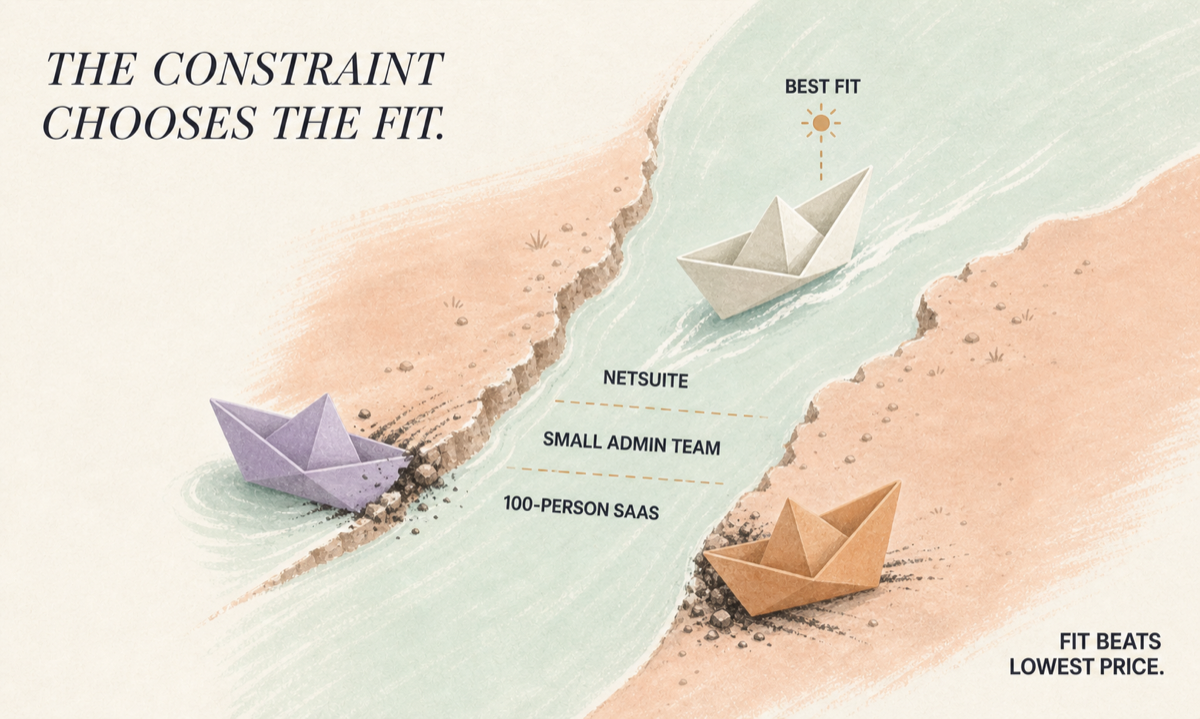
Write comparisons a buyer can trust
Use the same criteria for every option on a comparison page. Link feature claims to documentation, security statements to current policies, and customer outcomes to scoped case studies. Acknowledge meaningful limits. A candid comparison is more useful than declaring your product the universal winner.
Choose the first comparison from observed losses. Our guide to competitor replacement risk explains why a stable mention rate can coexist with a rival repeatedly winning recommendation prompts. If one competitor replaces you on high-value questions, build the evidence-backed comparison brief around the criteria those answers emphasize.
Fix 5: Build pages around segments, use cases, and constraints
A broad category page may be enough for “What are popular expense-management tools?” It often falls short once the buyer adds a consequential condition: a European entity, healthcare data, NetSuite, a 30-day deployment window, or a limited finance team.
Create a focused decision page when the combination represents a market you truly serve. The page should cover the buyer’s situation, required capabilities, implementation reality, limitations, and proof in one coherent resource.
Let the missing prompt choose the page
Suppose your brand appears on “best customer support platforms” but disappears on “best customer support platforms for healthcare teams that need a BAA.” That pattern points toward missing or weak evidence about the regulated use case. Another broad trends article won’t resolve it.
Work from the decision backward. What would a buyer need to verify before adding the product to a shortlist? That may include a security document, an integration guide, a deployment estimate with conditions, or a case study from a comparable organization.
Avoid cloning one template across 40 industries. Google’s guidance on people-first content emphasizes original information, substantial coverage, clear sourcing, and demonstrated expertise. One complete decision page serves buyers better than a network of thin pages with swapped industry names.
Fix 6: Strengthen the source footprint beyond your domain
Your own site defines the product. Buyers also validate that definition through review platforms, trade publications, associations, partner directories, marketplaces, analyst coverage, and serious community discussions. Those external descriptions can reinforce your category and fit, or contradict them.
Inspect which domains recur around your priority recommendation prompts. Look for patterns across multiple questions and providers:
- Do review sites dominate comparisons while your profile uses an outdated category?
- Do partner directories appear on integration prompts while your listing is missing?
- Do trade publications cover the problem but cite only established competitors?
Correct factual errors first. Then pursue substantive inclusion where the audience already looks for verification: current marketplace listings, contributed expertise with clear authorship, original research, partner documentation, or accurate review profiles. A pile of low-quality mentions and duplicated press releases adds volume without improving the buyer’s evidence.
Read sources without inventing causation
A cited domain tells you what the system attached to an answer. It doesn’t reveal the internal chain that caused a brand recommendation. Our guide to reading AI citations and sources shows how to use recurring domains as planning evidence without claiming that one URL produced one mention.
This distinction matters. If a respected review site appears repeatedly and omits your product, investigate its inclusion criteria and your profile. Don’t report that obtaining a listing will force the next model answer to change.
Your output is a prioritized source-gap list tied to observed prompts: domain, reason it matters, current accuracy, desired correction or contribution, owner, and status.
Fix 7: Publish evidence that is specific and easy to verify
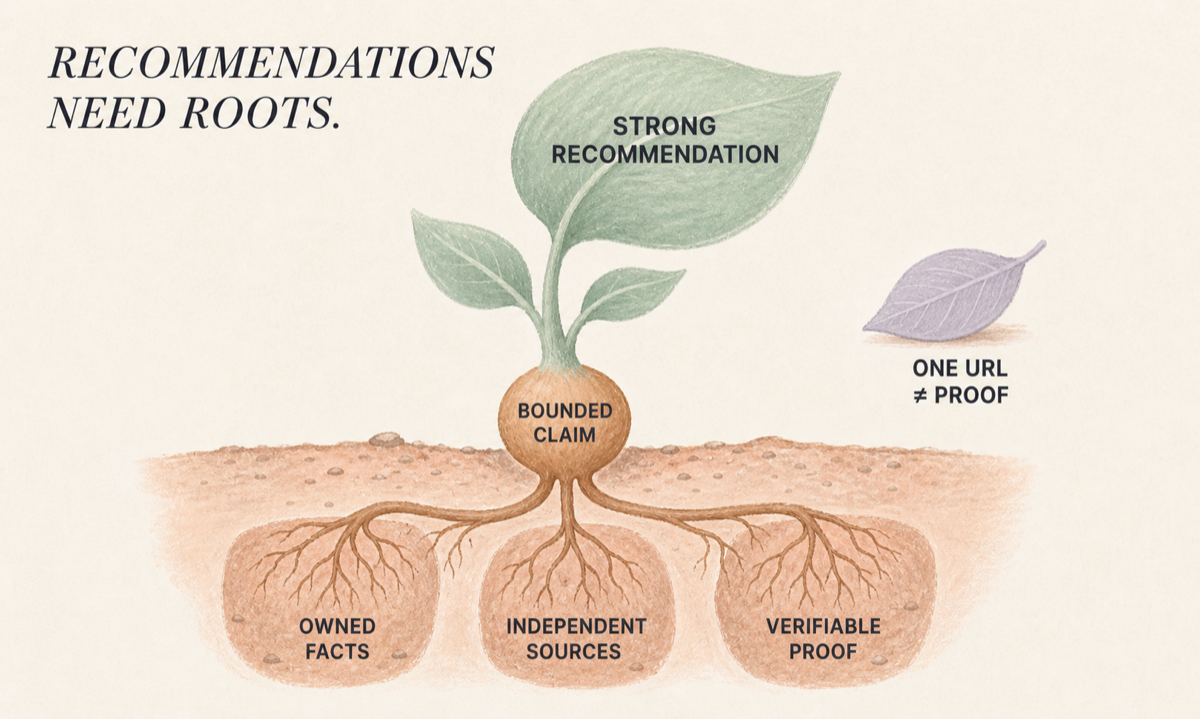
Models have little to work with when every claim sounds like campaign copy. “Built for scale” could describe nearly any software product. A dated benchmark with test conditions, a documented account limit, or a named customer result gives the claim boundaries.
Audit the statements behind your priority prompts. For each one, ask:
- What exactly are we claiming?
- Where is the primary evidence?
- What conditions or limitations apply?
- Who owns the fact, and when was it last checked?
Useful evidence includes current product documentation, transparent methodology, security and compliance details, pricing mechanics, benchmark conditions, sample sizes, implementation requirements, and customer examples with enough context to judge relevance. Name authors and reviewers where expertise matters.
Make each passage understandable on its own
Use descriptive headings and direct opening sentences. Keep a definition, claim, and its qualification close together. If a reader must assemble one answer from a hero slogan, a carousel, and a gated PDF, retrieval systems face the same fragmented presentation.
The 2024 Generative Engine Optimization study found that tactics including citations, quotations, and statistics improved source visibility in its benchmark, and that performance varied by domain. That finding supports testing clear, evidence-rich presentation. It does not establish a universal formula for brand recommendations.
Create an evidence inventory with columns for claim, proof URL, scope, owner, and last-updated date. Fix unsupported claims attached to late-stage prompts before polishing low-value educational pages.
Fix 8: Cover the FAQs that determine evaluation
The best FAQ inputs usually sit outside the content calendar. Sales hears integration objections. Support knows the edge cases. Security teams answer the same data-handling questions in every review. Implementation teams know which migrations require extra work.
Collect those questions and map them to the prompt gaps. Give priority to answers that change eligibility for a shortlist:
- Does the product integrate with a named system, and what is required?
- Which security or compliance commitments are current?
- How does migration work for a specific source platform?
- What determines price?
- Which use cases are outside the product’s intended fit?
Answer each question directly, then provide necessary detail and a path to verification. “Which tools connect to NetSuite without custom middleware?” requires a precise integration answer. A general article about the benefits of connected systems doesn’t satisfy the evaluation need.
Put the answer where the decision happens
Integration answers belong on integration or product pages. Security answers belong in maintained security resources. Pricing mechanics belong near pricing. A central FAQ can help navigation, though it shouldn’t become a warehouse for every question the company has collected.
Write for the buyer first. FAQ schema and query variants are secondary implementation choices. The concrete output is a backlog that assigns every decision question to a page, subject-matter owner, review date, and target prompt.
Fix 9: Remove crawl and extraction friction
Audit whether the evidence behind priority prompts is publicly reachable and present in readable HTML. Crawling and retrieval controls differ by provider, so check each provider’s published requirements instead of applying one crawler policy to every search and AI system.
Check the pages supporting your most important prompts for robots.txt rules, noindex directives, authentication, broken status codes, conflicting canonicals, weak internal links, and missing sitemap entries. Confirm that essential text renders without requiring an interaction that a crawler may never perform.
Separate search crawling from model training controls
OpenAI documents independent controls for its crawlers. OAI-SearchBot is used to surface websites in ChatGPT search results, while GPTBot relates to content that may be used to improve foundation models. A site can allow one and disallow the other. Review the policy with legal and security teams rather than treating every AI user agent as interchangeable.
Keep critical product facts in readable HTML. Videos, images, interactive accordions, and downloadable PDFs can supplement the page; they shouldn’t be the sole location for category, fit, integration, or policy information. Validate your structured data, inspect priority URLs, and make sure the experience still works well for human visitors.
Crawlability creates the conditions for discovery and retrieval. It doesn’t secure a recommendation. The deliverable is a technical checklist limited to the pages that support priority buyer questions, with each issue assigned to an owner.
Before you retest a fix, make the next check comparable: same questions, same models, same brand pool. The ShareOfAsk methodology lists what to keep stable and how to read changes.
A reusable prompt-repair worksheet
Keep the nine outputs in one working register rather than scattering them across separate documents. Copy the row below for each question-and-model pair, then replace the illustrative values with evidence from your own snapshot. This example is fictional; it shows the level of detail the register should contain.
| Field | Illustrative entry |
|---|---|
| Neutral buyer question | Which customer-support platforms should a 100-person B2B SaaS company using NetSuite evaluate? |
| Snapshot context | ChatGPT; 15 January 2026; unmodified response retained with the project record |
| Observed gap | Acme Support was absent. Vendor X was recommended and framed as the lower-friction NetSuite option. |
| Entity and category check | Use “customer-support platform for B2B SaaS teams” consistently; confirm that Acme Support is clearly connected to its parent company. |
| Comparison criterion | Document which NetSuite workflows are native, which require configuration, and where middleware is necessary. |
| Owned evidence or page | Update the NetSuite integration page with supported workflows, setup requirements, limitations, and a current product-owner review date. |
| External source gap | Correct the outdated integration description in the relevant marketplace listing. |
| Decision FAQ | “Can Acme Support connect to NetSuite without custom middleware?” Assign the answer to the integration page. |
| Technical check | Confirm the integration page returns a successful status, is indexable, appears in the sitemap, and is linked from the integrations directory. |
| Owner and re-test | Product marketing owns the page; partnerships owns the listing; re-run the same question after both changes are live. |
Product marketing owns the page; partnerships owns the listing; re-run the same question after both changes are live.
Preserve the raw answer beside the row so reviewers can distinguish what the model said from the team’s interpretation. On re-test, add the new mention and recommendation status, competitor framing, attached sources, and snapshot date without overwriting the baseline.
Choose the first two repairs, then re-test
Don’t turn nine fixes into nine simultaneous workstreams. Score each prompt gap on four dimensions: commercial importance, stability across repeated snapshots, breadth across models, and feasibility of repairing the evidence. This keeps a high-stakes comparison loss ahead of a harmless omission on an early educational question.
Use a practical order of operations:
- Correct factual errors, entity confusion, and access blocks.
- Address late-stage prompts where a competitor repeatedly wins.
- Improve category coverage and broader source gaps.

After a meaningful change, run the same neutral questions across the same models. Compare recommendation status, mention status, competitor context, descriptive framing, and recurring sources. Review several snapshots because model outputs vary from run to run and providers update over time.
We built ShareOfAsk for this measurement loop. Our snapshots preserve neutral buyer-style questions, unmodified responses, per-model outcomes, raw mention context, and trends. When competitors are configured, replacement patterns show who wins instead. Pro also includes evidence-backed Recommendations drawn from snapshot data.
Select the two highest-value missing prompts in your register. Assign the entity, content, competitive, PR, or technical repair each one requires; name an owner; and schedule the next measurement window after the changes are live. That gives your team a bounded experiment with observable outcomes rather than an open-ended AI visibility campaign.